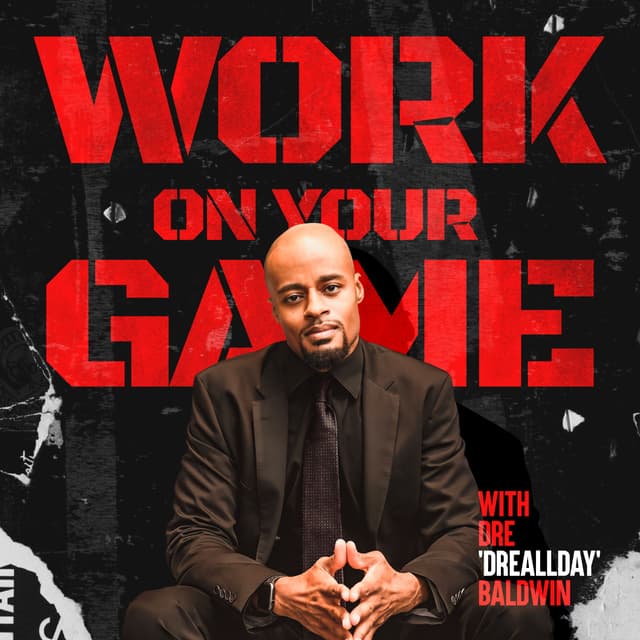
Work On Your Game: Discipline, Structure, and Execution Under Pressure
byDre Baldwin
Business
No Motivation. Just Standards. “Dre is the best at being real, direct, and strategic as a coach.” — Work On Your Game University Member Work On Your Game is the daily MasterClass for high performers who refuse to rely on motivation, talent, or guesswork to win. This is not inspiration. It’s execution architecture. Each episode sharpens how you think, decide, and act — so your results stop depending on mood, luck, or external validation. The work is built on four non-negotiables: • Discipline — doing the same things, the same way, every day • Confidence — earned through preparation and proof • Mental Toughness — sustained execution under pressure • Pers...
Episodes(40 episodes)
#3796: You're Afraid Of The Wrong Risks
Most people think they're avoiding risk when they choose to stay where they are. But doing nothing is still a decision, and the risk of staying the same can be far more expensive than the risk you're trying to avoid. The immediate danger gets your attention. The long-term cost often doesn't.
In this masterclass, I break down why people fear immediate pain more than future pain, why familiar risks feel safer than unfamiliar ones, and why inaction can become the biggest risk of all. Instead of asking which option feels safest today, I want you to ask which choice creates...
Published: Oct 5, 2026Duration: 26m 19s
#3795: Local Vs. Global Optimization
A lot of decisions look like wins when you only judge them by what happens right now. More money, a closed sale, winning an argument, choosing comfort, or getting the immediate result can all feel like victories. But a local win can create a global loss when you sacrifice the bigger outcome for the immediate one.
In this masterclass, I break down the difference between local and global optimization, why the best immediate option is not always the best overall option, and why high-level thinkers consider how one decision affects the entire system. The question isn't just, “What's the best mo...
Published: Oct 4, 2026Duration: 20m 9s
#3794: How To Think Like A Chess Player
Most people make decisions based on what happens right now. They see the immediate result, take the immediate win, and move on. But the decision you make today is often setting up another decision tomorrow, and the consequences that matter most may not show up until much later.
In this masterclass, I break down how to think like a chess player by looking beyond the current move, considering second and third-order consequences, and understanding how short-term wins can create long-term losses. The key question is simple: before you make a move, ask yourself, “Then what?”
Show Notes:
[07:27]#1 Every Decision Creates Anot...
Published: Oct 3, 2026Duration: 25m 50s
#3793: Stop Accumulating And Start Compounding
Most people measure progress by how much they have accumulated. More money, more followers, more knowledge, more content, more experience. But accumulation is linear. The higher level is learning how to turn what you've accumulated into something that keeps creating value without requiring the same amount of effort every time.
In this masterclass, I break down the difference between accumulation and compounding, why skills, trust, reputation, relationships, systems, and knowledge can compound, and how to structure your work so today's effort continues paying you in the future. The goal is not to do more forever. It's to make your effort...
Published: Oct 2, 2026Duration: 21m 8s
#3792: Obvious Symptoms Vs Deeper Signals
Most people react to whatever is right in front of them. The problem is, what's visible isn't always what's meaningful. A symptom gets your attention, but it doesn't necessarily tell you what actually needs to be fixed.
In this masterclass, I'm breaking down the difference between managing symptoms and solving problems. I explain why the first explanation is usually incomplete, why you need to keep asking questions, and why fixing the underlying signal can eliminate the symptoms altogether.
Show Notes:
[04:11]#1 Symptoms demand attention.
[08:16]#2 The first explanation is usually incomplete, if not the wrong explanation.
[14:45]#3 When you solve the signal, the...
Published: Oct 1, 2026Duration: 18m 28s
#3791: You're Getting Exactly What You're Reinforcing
Your results are rarely the product of one isolated event. Your life is shaped by feedback loops. What you repeatedly do creates patterns, those patterns create results, and those results influence what you do next. The loop matters more than any single win or loss.
In this masterclass, I break down how success and failure feed themselves, how repeated behaviors strengthen the cycles you're already living in, and why lasting change requires breaking destructive loops and reinforcing productive ones. You don't need to control every outcome. You need to learn how to design the loops producing those outcomes.
Show Notes:
[04:03]#1...
Published: Sep 30, 2026Duration: 17m 43s
#3790: You're Solving The Wrong Problem
Most of the time, the problem you're struggling with is not the real problem. You can spend hours, months, or even years trying to fix a symptom while the actual cause continues operating underneath it. When the diagnosis is wrong, every solution that follows becomes wasted effort.
In this masterclass, I break down why people treat symptoms instead of causes, why the obvious problem is rarely the real one, and why asking “why?” repeatedly can take you to the root cause. The fastest progress doesn't always come from doing more. It often comes from finally solving the right problem.
Show Note...
Published: Sep 29, 2026Duration: 21m 10s
#3789: Being Precise Doesn't Mean You're Accurate
Being precise does not mean you're right. Precision is about the level of detail in what you're saying, while accuracy is about whether you're actually addressing the point and moving in the right direction. A detailed, confident, highly specific argument can still be completely wrong.
In this masterclass, I break down why precision can create the illusion of credibility, why accuracy has to come before precision, and why great decision makers know how to simplify information without losing what matters. The goal is not to sound impressive. The goal is to communicate what is true and useful.
Show Notes:
[07:45]#1 Precision...
Published: Sep 28, 2026Duration: 20m 10s
#3788: Your Biggest Competition Is Invisible
Most people think competition means the other person, business, or player trying to beat them. But in reality, the biggest competition is often something you cannot see. Your prospects’ habits, distractions, comfort, inertia, convenience, and the status quo can all keep them from taking action.
In this masterclass, I break down why invisible competition is often stronger than the competition you can see, why convenience and familiarity quietly beat ambition, and why the best performers identify the real battlefield before they start working harder.
Show Notes:
[04:47]#1 Your Competition Is Bigger Than You Think
[09:37]#2 Invisible Competition Usually Wins By Default
[14:45]#3 The Best P...
Published: Sep 27, 2026Duration: 18m 51s
#3787: Don't "Optimize" Yourself Into Weakness
Most people assume optimization is always an advantage. But when you optimize too heavily for one outcome, you can sacrifice the flexibility you need when conditions change. The perfect system today can become a weakness tomorrow.
In this masterclass, I break down the hidden trade-offs behind optimization, why over-optimization reduces adaptability, and why high performers leave room for the unexpected. The goal isn't to become perfectly efficient. It's to remain effective no matter what changes around you.
Show Notes:
[03:01]#1 Perfect or Optimized Is Your Biggest Weakness
[10:23]#2 Over Optimization Reduces Adaptability
[17:40]#3 Leave Margin for the Unexpected
[22:11] Recap
---
Work With Dre
...
Published: Sep 26, 2026Duration: 23m 32s
#3786: You'll Never Outperform Who You Think You Are
You can temporarily perform at a level beyond how you see yourself, but you cannot sustain it if your identity has not caught up. Eventually, your old habits and self-image pull you back to what feels normal.
In this masterclass, I break down why your self-image sets your upper limit, why success beyond your expectations can create internal resistance, and how to raise your identity before you raise your goals, standards, or performance.
Show Notes:
[09:52]#1 Your Identity Sets the Upper Limit
[15:33]#2 Success Creates Internal Resistance
[19:59]#3 Raise Your Identity Before Your Goals
[28:45] Recap
---
Work With Dre
You don't need more...
Published: Sep 25, 2026Duration: 30m 12s
#3785: People Follow Incentives – Not Intentions
People will do what pays, not what they say. In this masterclass, I break down why incentives and consequences are the real drivers of human behavior.
I show you how to identify what is actually motivating someone, how bad incentives produce unintended behavior, and why the best leaders design incentive structures instead of relying on speeches or motivation.
Show Notes:
[03:58]#1 Every Behavior Is Rewarding Something
[08:16]#2 Bad Incentives Produce Bad Behavior
[17:47]#3 The Best Leaders Design Incentives, Not Speeches
[20:35] Recap
Next Steps:
---
Execution is not a talent.
It is a standard.
If your results don’t match your ability, something in your...
Published: Sep 24, 2026Duration: 22m 29s
#3784: How Momentum Can Hurt You
I’m breaking down why momentum is not always a good thing. You can be moving, working, checking boxes, and building momentum while actually heading in the wrong direction.
I explain why activity can create the illusion of progress, how momentum can keep you committed to bad decisions, and why high performers are willing to pause, reassess, and redirect when necessary. Direction matters more than speed.
Show Notes:
[05:13]#1 Movement is not the same as progress.
[10:40]#2 Momentum can trap you in yesterday's decisions.
[17:49]#3 Regular course corrections defeat blind acceleration.
[20:38] Recap
Episodes Mentioned:
2466: The Law Of Inertia
Next Steps:
---
Execution is no...
Published: Sep 23, 2026Duration: 22m 4s
#3783: "Hard To Get" Doesn't Mean Valuable
Scarcity is about supply, while rarity is about exceptional quality, and confusing the two can cause you to invest heavily in things that the marketplace doesn't actually value.
I explain why you should stop chasing scarcity and instead become rare by developing qualities like integrity, discipline, judgment, reliability, and wisdom. The goal is to become someone who is hard to replace, not simply someone who has something that's hard to get.
Show Notes:
[03:37]#1 Scarcity is about supply.
[10:50]#2 Rarity is about exceptional qualities.
[16:11]#3 Do not chase scarcity. Become rare.
[18:06] Recap
Next Steps:
---
Execution is not a talent.
It is a st...
Published: Sep 22, 2026Duration: 20m 7s
#3782: Most People Don't Want Freedom
Most people say they want freedom but actually want permission. Freedom means making your own decisions, taking responsibility for the consequences, and moving without waiting for someone else to validate your choice.
I explain why permission feels safer than responsibility, why real freedom requires self-authorization, and why the highest-level performers create their own rules instead of waiting for someone else to tell them what they can do.
Show Notes:
[03:02]#1 Permission feels safer than responsibility.
[07:31]#2 Freedom requires self-authorization.
[11:46]#3 The highest-level performers create their own rules.
[15:25] Recap
Next Steps:
---
Execution is not a talent.
It is a standard.
If your results do...
Published: Sep 21, 2026Duration: 16m 38s
#3781: Attention Is Cheap, Respect is Expensive
Getting noticed is not the same as being valued. Attention can be generated quickly through controversy, entertainment, or shock, but respect takes consistency, substance, competence, discipline, and results. If you want lasting influence and better opportunities, focus on building respect rather than constantly chasing attention.
Show Notes:
[07:27]#1 Anyone can generate attention.
[10:59]#2 Respect is built through consistency.
[14:11]#3 Respect produces better opportunities than attention.
[18:08] Recap
Next Steps:
---
Execution is not a talent.
It is a standard.
If your results don’t match your ability, something in your approach is out of alignment.
Most people do not have a motivation problem.
They have a...
Published: Sep 20, 2026Duration: 19m 31s
#3780: How Notifications COOK Your Brain
Constant notifications can train you to react instead of intentionally focus. Every interruption pulls your attention away from what you were doing, and repeatedly responding to those interruptions can make distraction feel normal. The solution is to protect your attention by reducing unnecessary notifications and creating uninterrupted time to think and work.
Show Notes:
[09:52]#1 Your attention gets hijacked.
[13:28]#2 Your brain starts craving the interruption.
[18:38]#3 Deep thinking requires long periods of nothingness except thinking.
[24:23] Recap
Next Steps:
---
Execution is not a talent.
It is a standard.
If your results don’t match your ability, something in your approach is out of a...
Published: Sep 19, 2026Duration: 32m 42s
#3779: Why Boredom Is Your Secret Weapon
Today, I’m breaking down why boredom can become one of your greatest competitive advantages. Mastery is built through repetition, focus, and continuing to do the work after the excitement and novelty have worn off. If you can tolerate the boredom that makes other people quit, you can develop a level of consistency that produces extraordinary results.
Show Notes:
[04:50]#1 Boredom is where mastery is built.
[08:25]#2 Distraction is a new competition.
[16:00]#3 Consistency feels boring before it looks extraordinary.
[18:38] Recap
Next Steps:
---
Execution is not a talent.
It is a standard.
If your results don’t match your ability, something in your a...
Published: Sep 18, 2026Duration: 20m 2s
#3778: You Get What You Earn – Not What You Deserve
There is a difference between what you think you deserve and what you actually earn. Effort, intention, and potential are necessary, but they do not guarantee an outcome. The marketplace responds to tangible value and results, so the better question is not what you deserve, but what you can do to make yourself impossible to ignore.
Show Notes:
[07:21]#1 Deserving is subjective.
[12:37]#2 Earning is measured by outcomes.
[16:29]#3 Replace entitlement with leverage.
[20:15] Recap
Next Steps:
---
Execution is not a talent.
It is a standard.
If your results don’t match your ability, something in your approach is out of alignment.
Most peop...
Published: Sep 17, 2026Duration: 21m 43s
#3777: High Level Competence Is Invisible
I’m breaking down why true competence often goes unnoticed. The highest-level performers make difficult things look easy because the preparation, repetition, and problem-solving happened before anyone was watching. Real expertise prevents problems, creates stability, and makes the work look effortless.
Show Notes:
[04:31]#1 Competence makes difficult things look easy.
[10:17]#2 The best work happens before anyone notices.
[21:27]#3 Incompetence draws attention. Competence does not.
[23:05] Recap
Episodes Mentioned:
931: What Is Expected When "Professional" Is Next To Your Name
Next Steps:
---
Execution is not a talent.
It is a standard.
If your results don’t match your ability, something in your approach is out of...
Published: Sep 16, 2026Duration: 24m 58s