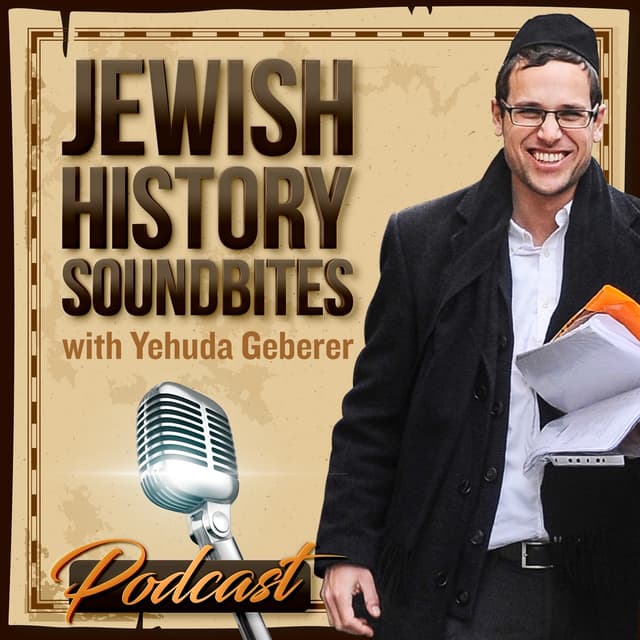
Jewish History Soundbites
byYehuda Geberer
HistoryJudaismReligionSpirituality
Listen to noted Tour Guide, Lecturer and Yad Vashem Researcher of Jewish History Yehuda Geberer bring the world of pre-war Eastern Europe alive. Join in to meet the great personages, institutions and episodes of a riveting past.For speaking engagements or tours in Israel or Eastern Europe Yehuda@YehudaGeberer.com
Episodes(40 episodes)
Episode 485
Moscow & Expulsions: Another Look
The story of the expulsion from Moscow in 1891 was told at length in the previous episode of Jewish History Soundbites. The feedback generated from that saga has led to another look at two related topics. Expulsions of Jews in recent history, and the Moscow Jewish community under the Czars. Regarding the former, what constitutes an expulsion? Is it limited to a formal expulsion edict, or living conditions that are nearly impossible for Jews that they are forced to leave? What was the Moscow Jewish community like at the turn of the 19th and 20th centuries? Who were the members...
Published: Mar 21, 2026Duration: 47m 54s
Episode 484
Expulsion from Moscow 1891
The Jewish community of Moscow in the late 19th century was composed of Russian Jews who were permitted residence outside of the Pale of Settlement. In 1891 the Czarist government reversed its policy of selective integration and about 30,000 Jews were expelled from Moscow. This expulsion was a tragedy for the refugees, and a sense of disillusionment for Russian Jewry at large. Its reverberations were felt in the realm of emigration, radicalization and the rise of Zionism. More broadly, the phenomenon of expulsion itself as a recurring tragedy in Jewish history, is a bit unique in the case of Moscow.
<...
Published: Mar 14, 2026Duration: 50m 48s
Episode 483
Rav Fishel of Strikov & the Spread of the Chassidic Movement
Although not as well known as some of his contemporaries, Rav Efraim Fishel of Strikov (1745-1825) served in a crucial role during the formative stages of the chassidic movement. Like his father before him he was a student of the Maggid of Mezritch. He later was a pioneer in establishing one of the first formal chassidic courts in Congress or central Poland. As a charismatic holy figure, as well as a rabbinical scholar serving as a communal rabbi, he gained followers, some of whom went on to emerge as some of the greatest leaders of 19th century Polish chassidus...
Published: Mar 7, 2026Duration: 42m 15s
Episode 482
Rav Avraham Landau of Chechenov & the Strikov Chassidic Dynasty
One of the most influential rabbinical and chassidic leaders of central Poland in the 19th century, Rav Avraham of Chechenov (1784-1875) served as a rabbi of Chechenov for 55 years, while also playing an important role in the development of the chassidic movement in Poland. His descendants founded the prominent Strikov dynasty, among others, and served in crucial roles during challenging times facing Polish Jewry.
Subscribe to Jewish History Soundbites Podcast on: PodBean: https://jsoundbites.podbean.com/ or your favorite podcast platform
Follow us on LinkedIn, Twitter or Instagram at @Jsoundbites
For sponsorship opportunities...
Published: Feb 28, 2026Duration: 57m 33s
Episode 481
Jews & Muslims in Moroccan Jewish History
Despite discrimination against Jews under Muslim rule throughout Moroccan Jewish history, there was still an unusual relationship that Jews and Muslims had in Morocco. This was especially true with the native Berbers. From Muslims praying at the graves of Jewish tzadikim, to close business ties, sharing festivities, prayers and other life cycle events, Muslims and Jews in Moroccan Jewish history had an interesting relationship. The seeming downside of this closeness was the prevalence of conversion of Jews to Islam, both forced and even voluntary.
Subscribe to Jewish History Soundbites Podcast on: PodBean: https://jsoundbites.podbean.com/ or...
Published: Feb 21, 2026Duration: 29m 34s
Episode 480
The Development of American Postwar Yeshivos
Reflecting upon the phenomenal growth of the American Yeshiva society in the second half of the 20th century, one tends to focus on the great accomplishments of individual leaders such as Rav Aharon Kotler, Rav Shraga Feivel Mendlowitz, the Lubavitcher Rebbe, the Satmar Rav, institutions such as Torah Umesorah, RIETS, RJJ, BMG and other internal development within American Orthodoxy. However there's a broader narrative, with gradual processes taking place in broader American society which facilitated the growth of yeshivos during this time. Economic, social and demographic changes in the United States in the postwar era, LBJ's Great Society and...
Published: Feb 14, 2026Duration: 44m 8s
Episode 479
Come on and Ride the Train: The Kastner Story Part IX
In this final installment of the Kastner train series, the legacy of the Kastner trial is explored in three ways. In a series of interviews in 1957 known as the Sassen documents, Adolf Eichmann described his view of the role that Kastner played in the negotiations. In 1961 famed Hollywood screenwriter and novelist Ben Hecht authored Perfidy, a harsh critique of Kastner and the Zionist leadership. Who was Ben Hecht and what are the limitations of Perfidy. Finally, a broad swath of scholars, historians, historical figures and writers are presented in a sweeping summary of the spectrum of views criticizing and...
Published: Feb 7, 2026Duration: 1h 6m 39s
Episode 478
Come on and Ride the Train: The Kastner Story Part VIII
Who were the primary characters involved in the Kastner trial and how did their personal life stories impact the trial proceedings? What did the witnesses at the trial reveal about the Kastner negotiations? What was discussed and what wasn’t discussed about the Holocaust in Hungary at the trial? What was the verdict of the trial? How did the Supreme Court react to the verdict of the lower court? All this and more as we continue to explore the contentious history of the Kastner train and trial.
Subscribe to Jewish History Soundbites Podcast on: PodBean: https://jsoundbites.po...
Published: Jan 31, 2026Duration: 1h 17m 16s
Episode 477
[RERELEASE] The 1837 Tzfas Earthquake (replay)
Reposted with a new introduction, this episode will serve as a temporary break from the ongoing series on the Kastner train.
On January 1, 1837, a devastating earthquake hit the upper Galilee and southern Lebanon, destroying towns, villages, property and roads, disrupting commerce and claiming the lives of thousands of victims. The ancient and mystical city of Tzfas was essentially destroyed at the epicenter of the earthquake’s damage, with most of its citizens killed, and the remainder being rendered homeless and penniless in the wake of this natural disaster. The traumatic event left a decisive impact on the tr...
Published: Jan 24, 2026Duration: 55m 42s
Episode 476
Come on and Ride the Train: The Kastner Story Part VII
Following the war’s end in 1945, the controversy surrounding Kastner’s wartime activities began to emerge. Some pointed to the fact that he rescued an entire trainload of Jews, while others accused him of failing to warn Hungarian Jewry of the impending deportations to Auschwitz. The Jewish People in general and Israeli society in particular were reeling from the trauma of the Holocaust. The trial involving the story of Kastner and his negotiations takes place in the context of Israeli society of the 1950’s. Two salient features hover in the background across broader society. A traumatized people facing not its mu...
Published: Jan 17, 2026Duration: 1h 9m 46s
Episode 475
Come on and Ride the Train: The Kastner Story Part VI
The Satmar Rav, Rav Yoel Teitelbaum, was rescued on the Kastner train. How did this great leader of Hungarian Orthodoxy and chassidic community, who was well known for his vocal opposition to Zionism, receive a place of rescue on the train which was organized by the secular Zionist Aid and Rescue Committee of Budapest? Insights into his inclusion broadens our understanding of how the rescue train story developed. Other famous individuals were rescued on the Kastner train as well. In conclusion it’s worth summarizing the entire story of the negotiations with the SS and the rescue train’s depa...
Published: Jan 10, 2026Duration: 1h 4m 36s
Episode 474
Come on and Ride the Train: The Kastner Story Part V
Who ultimately got rescued on the Kastner train? How was the list assembled? What were the SS criteria for those Jews to be included on the list? How diverse was the representation of the various factions of Hungarian Jewry on the train? Who financed the bribes to the SS in order for the train to be rescued? On this episode the discussion shifts to the actual composition of those rescued on the train, what role did Rudolf Kastner himself play in assembling the final list, the SS perspective on who should be included on the train and how it...
Published: Jan 3, 2026Duration: 59m 31s
Episode 473
Come on and Ride the Train: The Kastner Story Part IV
What were the actual negotiations between Kastner and other Jewish rescue leaders and Eichmann and the SS? How were the negotiations initiated and how did they develop? When did they take place? Who were the personalities on the negotiating team on each side? What were the goals of the SS in the negotiations and what were the goals of the Jewish rescue leaders like Kastner? The tense negotiations proceeded over the course of April-June 1944 in Budapest, and went through several stages. Understanding the who, when and why of the negotiations themselves, will broaden our understanding of the entire Kastner...
Published: Dec 27, 2025Duration: 54m 59s
Episode 472
Come on and Ride the Train: The Kastner Story Part III
On April 7, 1944 two Slovakian Jews named Rudolf Vrba & Alfred Wetzler made a daring escape from Auschwitz and made their way back to Slovakia. They submitted a detailed and accurate report of the horrifying truth of the Auschwitz extermination facilities, along with details regarding the transports arriving in the camp and the overall camp structure. The Slovakian Jewish leadership attempted to pass on the vital information to the outside world, and crucially to the Hungarian Jewish leadership as well. Although the Hungarian Jewish leadership received the information by the end of April, the truth about Auschwitz was not disseminated to...
Published: Dec 20, 2025Duration: 59m 55s
Episode 471
Come on and Ride the Train: The Kastner Story Part II
What did Hungarian Jewry look like on the eve of World War II? What was its size, religious composition and communal organization? What happened to Hungarian Jewry prior to the Nazi invasion in March 1944? What were the Nazi plans for Hungarian Jewry following the occupation? How were the deportations carried out and what was their scope? Who was the Jewish leadership in Budapest during this time? What were the roles of the Neolog (Hungarian Reform), Orthodox, secular and Zionist leaders in Budapest during the Nazi occupation? This overview will provide much needed context to understand the broader story of...
Published: Dec 13, 2025Duration: 1h 3m 21s
Episode 470
Come on and Ride the Train: The Kastner Story Part I
NEW SERIES ON JEWISH HISTORY SOUNDBITES
On June 30, 1944, a train departed Budapest, Hungary, carrying 1,684 Jews as its passengers. This occurred during the peak of the Nazi deportations of Hungarian Jewry to Auschwitz in the horrific summer of 1944. This particular trainload however, following a short stint in the Bergen-Belsen concentration camp, was permitted to cross the border into Switzerland and freedom. The entire project was orchestrated through direct negotiations with the SS through the efforts of a young Zionist leader in Budapest named Rudolf Kastner. Though the lives of those on the train were saved, the entire operation...
Published: Dec 6, 2025Duration: 44m 29s
Episode 469
Self-hating Jews in Jewish History
Unfortunately the phenomenon of isolated instances of Jews consumed with self hatred, while projecting antisemitic stereotypes on their brethren is nothing new. It has existed in one form or another throughout Jewish history. This historical saga is worth examining, coupled with specific stories of Jewish self hatred during the Nazi era.
Subscribe to Jewish History Soundbites Podcast on: PodBean: https://jsoundbites.podbean.com/ or your favorite podcast platform
Follow us on LinkedIn, Twitter or Instagram at @Jsoundbites
For sponsorship opportunities about your favorite topics of Jewish history or feedback contact Yehuda at: yehuda@y...
Published: Nov 1, 2025Duration: 44m 45s
Episode 468
Marriage Age in Jewish History
During the 18th & first half of the 19th centuries, many members of the financial and rabbinical elite in Jewish Eastern Europe engaged in the practice of marrying off their children at a very young age. Why did they do that? How widespread was this practice? Why did it end? And what ramifications did this have on European Jewish life during this time and afterwards?
Subscribe to Jewish History Soundbites Podcast on: PodBean: https://jsoundbites.podbean.com/ or your favorite podcast platform
Follow us on LinkedIn, Twitter or Instagram at @Jsoundbites
For sponsorship opportunities...
Published: Oct 25, 2025Duration: 43m 18s
Episode 467
RERELEASE: Tales of Sukkos & Simchas Torah (update)
In honor of the upcoming Sukkos & Simchas Torah holidays, here's an updated version of an old episode of Jewish History Soundbites, containing entertaining historical tales & tidbits from Jewish history. With updates and additions to enjoy.
Subscribe to Jewish History Soundbites Podcast on: PodBean: https://jsoundbites.podbean.com/ or your favorite podcast platform
Follow us on LinkedIn, Twitter or Instagram at @Jsoundbites
For sponsorship opportunities about your favorite topics of Jewish history or feedback contact Yehuda at: yehuda@yehudageberer.com
Published: Oct 4, 2025Duration: 45m 59s
Episode 466
Tribute to Rav Dovid Kamenetsky
Torah scholar, author of many acclaimed seforim on the Torah of the Vilna Gaon and others, historian and author of the definitive work on Rav Chaim Ozer Grodzinski, are just a few of the many accomplishments of Rav Dovid Kamenetsky. His untimely passing leaves a void in the realm of his important historical research, but more importantly in what he represented as a person. He was beloved by all who knew him, whether it was in the National Library where he conducted his research for over four decades, or in his many interactions in his personal and professional life...
Published: Sep 20, 2025Duration: 46m 37s